


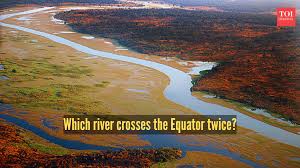
Nature never fails to surprise us, and some of its wonders are so rare that they stand alone in the world. One such marvel is a river that doesn’t just cross the Equator once—but twice. That extraordinary river is Africa’s mighty Congo River.
🌊 The Congo River: A One-of-a-Kind Natural Wonder
The Congo River, earlier known as the Zaire River, is Africa’s second-longest river after the Nile. Globally, it ranks as the third-largest River by discharge, surpassed only by the Amazon and the Ganges–Brahmaputra system. What truly sets it apart, however, is its remarkable geographical journey.
The Congo is the only major river in the world that crosses the Equator twice, making it a rare geographical phenomenon.
🗺️ Where Does the Congo River Begin?
The Congo originates high on the savanna plateaus of the East African Rift, with its earliest tributaries rising near Lake Tanganyika. From this elevated region, the river begins a long, winding journey through the heart of Africa.
🌐 Crossing the Equator—Twice
As the Congo flows westward and northward, it first crosses the Equator, entering the Northern Hemisphere. Instead of continuing straight, the river then curves in a broad counter-clockwise arc.
This sweeping bend sends it southward once again, causing it to cross the Equator a second time before it finally turns southwest and empties into the Atlantic Ocean.
This serpentine route across Earth’s midline is unmatched by any other major on the planet.
📏 Size, Strength, and Steady Flow
Measured along its longest tributaries, the Congo stretches approximately 4,700 kilometres, making it one of the longest rivers in the world. It flows through the vast Congo Basin, a drainage area covering millions of square kilometres—around 13% of Africa’s total land area.
Because the basin lies close to the Equator and spans both hemispheres, it receives rainfall throughout the year. This climatic stability allows the Congo to maintain a powerful and consistent flow.
🌊 The World’s Deepest Measured Freshwater Channel
Another astonishing fact: the Congo is also considered the deepest measured freshwater channel in the world. In parts of the Lower Congo, depths exceed 220 metres.
This depth, combined with immense volume and steady movement, creates ideal conditions for an astonishing variety of life.
🐒 A Biodiversity Hotspot
The Congo Basin ranks among the planet’s richest ecosystems. It is home to thousands of plant and animal species, many of them endemic to its forests and freshwater environments. This plays a vital role in sustaining ecological balance across Central Africa.
🤝 A Waterway That Connects Nations and People
As the Congo winds through Central Africa, it connects landscapes, cultures, and communities. Its waters act as highways for trade and transport, supporting fishing, agriculture, and daily life in regions where roads are limited.
By crossing both hemispheres, the Congo links diverse climates and ecosystems—rainforests, savannas, and wetlands—making it a natural bridge across the continent.
✨ Final Thoughts
The Congo is far more than a flowing body of water. It is a geographical rarity, an ecological powerhouse, and a lifeline for millions. Its unique distinction as the only major freshwater system to cross the Equator twice makes it one of nature’s most fascinating wonders.