


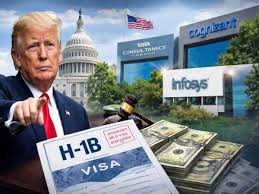
US President Donald Trump’s latest move to tighten Trump’s H-1B visa programme could dramatically reshape the global IT outsourcing landscape. Trump’s proposed $100,000 fee for fresh H-1B workers recruited from abroad is expected to hit Indian IT giants such as Tata Consultancy Services (TCS), Infosys, and Cognizant the hardest, according to a Bloomberg News analysis.
This potential policy shift represents one of the strictest restrictions yet under Trump’s immigration agenda on skilled foreign worker employment in the United States.
💰 The Proposed $100,000 H-1B Fee: What’s Changing?
The Trump administration has proposed a massive hike in fees for companies hiring new H-1B workers from overseas. If implemented, the $100,000 levy per visa would mark a dramatic increase over existing costs and significantly raise hiring expenses for companies dependent on global talent.
Industry experts believe this move is aimed at discouraging reliance on foreign professionals and encouraging domestic hiring.
📘 Understanding the H-1B Programme
The H-1B visa programme is the primary route for foreign professionals with at least a bachelor’s degree to work in the US. Each year, 85,000 visas are issued, and large technology and IT services firms typically secure a significant share of these slots.
While critics argue that companies use H-1B visas to avoid hiring American workers at higher salaries, regulations mandate that employers pay industry-standard wages. In fact, many entry-level H-1B professionals earn more than the US median salary.
🏢 Why TCS, Infosys, and Cognizant Face the Biggest Impact
According to Bloomberg’s analysis, Indian IT firms would have faced enormous additional costs if the proposed fee had been in effect earlier.
Between May 2020 and May 2024:
-
Around 90% of new H-1B appointments at TCS, Infosys, and Cognizant were approved at US consulates.
-
This means the majority of their hires would have been subject to the $100,000 fee.
📊 Estimated Impact by Company
-
Infosys: Over 10,400 workers (93% of new H-1B approvals), potentially exceeding $1 billion in visa costs.
-
TCS: Around 6,500 workers, impacting 82% of new H-1B hires.
-
Cognizant: More than 5,600 employees, accounting for 89% of its new H-1B recruits.
🔮 What Does the Future Hold for H-1B Visas?
Even if courts intervene to block the fee, analysts expect:
-
A sharp drop in H-1B visa applications
-
Greater reliance on offshore and near-shore staffing models
Immigration attorney Jonathan Wasden, who represents several IT employers, noted that companies are already adjusting their strategies. He warned that exceptional global talent could miss out on US opportunities if restrictions continue.
🏭 Industry Responses: Adapting to the New Reality
Some companies believe the short-term impact will be manageable.
-
Cognizant stated that the proclamation would have limited near-term impact on operations, citing reduced reliance on visas and selective use for niche roles.
-
IBM, which recruited 88% of its H-1B workers internationally, has also refined its skilled immigration strategy to better align with evolving client needs.
Meanwhile, DHS officials under the Biden administration previously flagged misuse of the H-1B system, leading to lottery changes. The proposed fee is now being positioned as a measure to prevent companies from “spamming the system” and suppressing wages, according to White House spokesperson Taylor Rogers.
🌍 Increased Offshoring and Global Talent Shifts
The IT consultancy sector has already reduced new H-1B applications since 2024. Experts predict the fee hike will further accelerate:
-
Offshore hiring
-
Increased investment in India and other talent hubs
Steve Hall, Chief AI Officer at Information Services Group Inc., summed it up:
“If you want to access the world’s best talent, you have to go where the talent is.”
⚖️ Will the Fee Actually Change Hiring Behavior?
Howard University political scientist Ron Hira believes the fee could lead to a higher-skill, higher-wage workforce, though companies will inevitably find ways to adapt.
Legal tech firm Lawfully forecasts that the combined effect of the new fee and lottery changes could reduce H-1B lottery entries by 30% to 50% next year, especially among employers requiring consular processing.
🧾 Final Thoughts
Trump’s proposed $100,000 H-1B fee could be a turning point for global IT staffing. While intended to protect American jobs, it may accelerate offshoring, reshape talent strategies, and significantly impact Indian IT majors that have long relied on the programme.