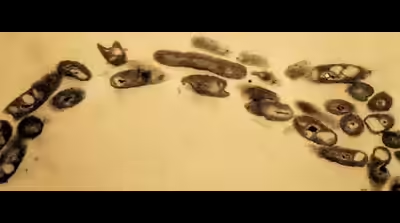
Hyderabad has become the centre of a remarkable scientific breakthrough. Researchers who earlier discovered a petroleum-eating bacterium in Nacharam have now decoded its entire genome — boosting hopes for a natural, eco-friendly method to clean oil-polluted soils.
🔬 Discovery of a Powerful Oil-Degrading Strain
About six months ago, scientists isolated a new bacterial strain, Rhodococcus indonesiensis SARSHI1, from contaminated soil near petrol stations and industrial areas in Nacharam.
Their earlier study, published in Nature Scientific Reports, involved soil sampling at depths of 10 cm to 1 metre. From 72 samples, five strains showed strong oil-degrading abilities and produced biosurfactants — natural molecules that help break down oil.
🧪 Key highlights of SARSHI1:
-
🚀 ~90% hydrocarbon degradation efficiency
-
💧 High biosurfactant production
-
🌱 No phytotoxicity (environment-safe)
-
🧱 Strong adaptation to polluted soil
This made SARSHI1 a top candidate for large-scale bioremediation, especially in industrial zones affected by petroleum leaks.
🌏 Why This Matters
Oil pollution caused by spills, industrial discharge, and leakage is a global environmental issue. Traditional cleanup methods are expensive and slow.
A naturally existing bacterium that eats oil is a revolutionary, sustainable alternative. 🌿
🧬 Genome Decoded: What the New Study Reveals
In the latest research published on December 2 in Scientific Reports, scientists led by Anuraj Nayarisseri and Rajabrata Bhuyan successfully decoded the complete genome of SARSHI1.
🧫 Sequencing details:
-
🧬 5.7 Mbp genome
-
🧪 159,118 bp plasmid
-
🔍 5,220 genes annotated
-
📈 100% genome completeness
-
⚙️ 91.4% coding density
This high-quality genome map provides deep insight into the bacterium’s oil-degrading abilities.
🧪 Genes That Help Break Down Oil
The functional analysis identified essential genes responsible for breaking down different petroleum compounds.
🔥 Long-chain alkane degradation genes:
-
alkB
-
ahyA
-
almA
🛢️ Aromatic hydrocarbon degradation genes:
-
bph
-
ben
-
xylC
These genes serve as a powerful enzymatic toolkit, enabling SARSHI1 to degrade both simple and complex hydrocarbon pollutants.
The bacterium also carries genes for:
-
🛡️ Antibiotic resistance
-
⚗️ Secondary metabolite production
This helps it survive in harsh, contaminated environments.
🌿 A Step Closer to Natural Oil Cleanup
With the genome fully decoded, SARSHI1 now stands as one of the most promising candidates for industrial-scale bioremediation.
Its natural ability to break down oil—while producing biosurfactants—could revolutionize how polluted soils are restored.
📚 The genome data is publicly available in GenBank for further research.
💡 Final Thoughts
The decoding of the SARSHI1 genome is more than just a scientific achievement — it’s a potential game-changer for environmental restoration. What started as a discovery in a polluted corner of Nacharam could soon help clean contaminated lands across India and the world.
With its efficiency, safety, and powerful genetic capabilities, this tiny microbe may become a big solution to one of the planet’s persistent problems. 🌎✨










Leave A Comment