
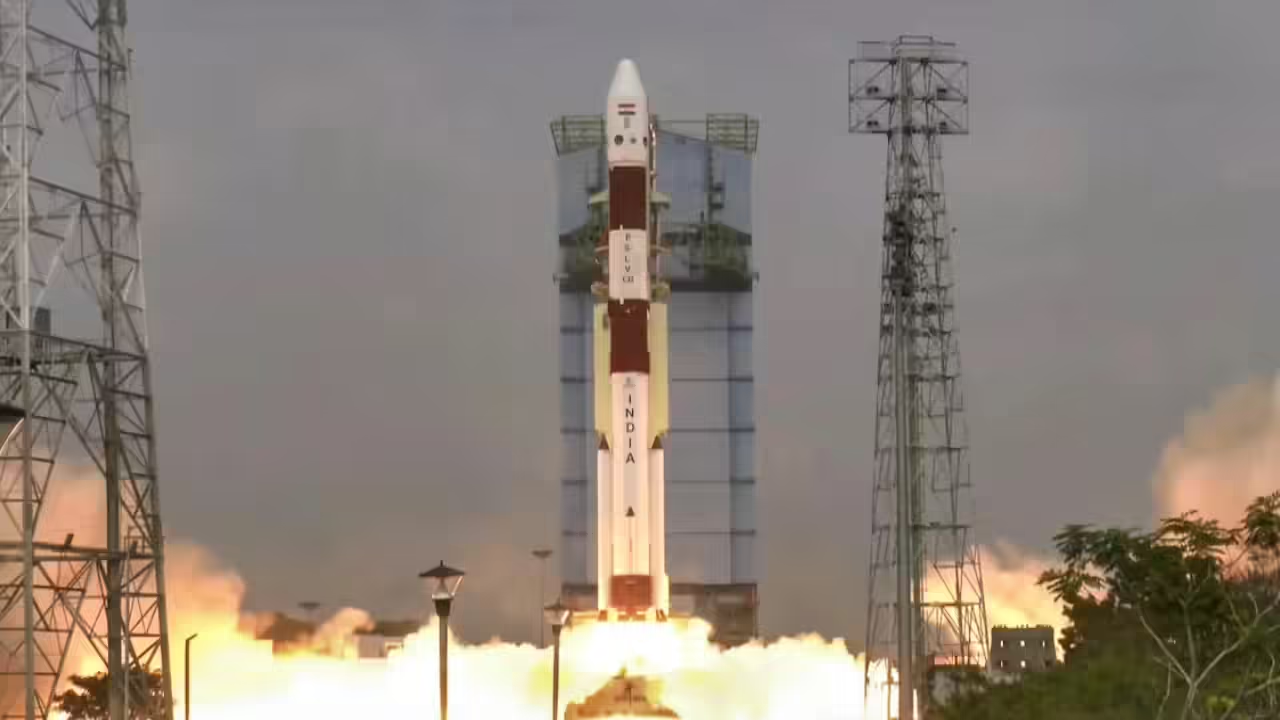
On January 12, 2026, the Indian Space Research Organisation (ISRO) launched its first mission of the year — PSLV-C62 — from the Satish Dhawan Space Centre in Sriharikota. The mission, carried out using the PSLV-DL variant, was designed to place multiple advanced satellites into orbit.
However, what began as a promising launch encountered a critical issue during flight, raising fresh concerns about ISRO’s recent mission reliability.
🚀 Mission at a Glance
The PSLV-C62 rocket stood 44.4 meters tall and was tasked with deploying an advanced Earth-observation satellite along with multiple experimental payloads.
Primary Payload
-
EOS-N1 (Anvesha) – A hyperspectral Earth-observation satellite built for high-resolution surveillance, environmental monitoring, and data-driven decision-making.
Secondary Payloads
The mission also carried several cutting-edge technology demonstrators, including:
-
AayulSAT – A satellite refueling experiment in orbit
-
KID Re-entry Capsule – A European spacecraft to test atmospheric re-entry
-
14 co-passenger satellites and CubeSats for scientific, IoT, and AI-based experiments
This was also a commercial mission operated by NewSpace India Limited (NSIL), highlighting ISRO’s growing role in the global space market.
⚠️ What Went Wrong?
According to ISRO Chairman V. Narayanan, the mission initially progressed normally.
-
Stage 1 and Stage 2 performed as expected
-
Stage 3 (PS3), however, experienced disturbances toward the end of its burn
These disturbances caused a deviation in the rocket’s flight path, preventing the mission from proceeding as planned. ISRO engineers are now analyzing telemetry data to identify the exact cause of the anomaly.
📊 Why This Matters
This setback is particularly significant because:
-
PSLV-C62 was ISRO’s first mission of 2026
-
It follows a similar third-stage failure in PSLV-C61 in May 2025
-
The mission involved critical technology demonstrations, including AI-enabled onboard processing and IoT-based satellite services
Repeated third-stage anomalies could indicate deeper technical challenges that ISRO may need to address before future launches.
🗣️ Public Reaction
The Times of India article’s comments section reflects mixed public sentiment.
While many praised ISRO for being transparent and honest about the failure, others expressed concern over the increasing number of recent setbacks in what was once considered one of the world’s most reliable launch systems.
🔮 Conclusion
While the PSLV-C62 mission did not go exactly as planned, it represents another important learning curve in India’s ambitious space journey. Every anomaly provides valuable data that helps engineers refine systems, improve reliability, and strengthen future missions.
ISRO has repeatedly proven its ability to bounce back from challenges, and this setback is unlikely to slow its long-term momentum. As investigations continue and corrective measures are put in place, India’s space program remains firmly on track — aiming higher, learning faster, and pushing the boundaries of innovation.










Leave A Comment