


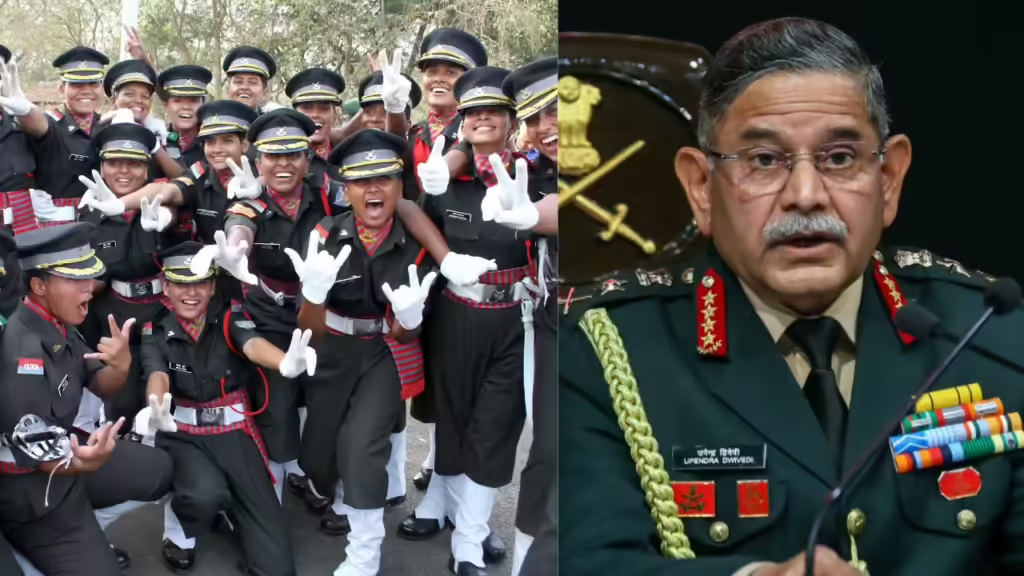
The Indian Army is prepared to take a historic step toward gender-neutral combat roles, but societal readiness remains a key factor. Army Chief General Upendra Dwivedi has stated that women can be inducted into infantry combat roles as soon as India as a society is ready to accept the change.
⚔️ Army’s Stand on Women in Infantry
Speaking at a media briefing in New Delhi, General Dwivedi emphasized that the Army does not view as a “vulnerable commodity.” Instead, the focus is firmly on gender neutrality and capability-based selection.
“If standards are the same, if capabilities are the same, and if Indian society is ready to accept it, combat roles for can be done tomorrow,” he said.
Uniform standards remain non-negotiable, though medical and operational challenges continue to be a hurdle.
📊 A Phased and Data-Driven Approach
The expansion of women’s roles in the Army will follow a structured, evidence-backed progression:
-
Supporting Arms
-
Combat Arms
-
Special Forces
Performance data of women officers will determine the pace of this transition, described by the Army Chief as a welcome social evolution.
👩✈️📈 Current Statistics and Future Projections
The Army has already taken concrete steps to enhance women’s participation:
Present Strength
-
Total Women Officers: ~8,000
-
NDA: 60 cadets; 20 to be inducted annually
-
OTA (Chennai & Gaya): 120 women officers per year
Other Ranks (ORs)
-
Requires amendment to Section 12 of the Army Act
-
Targeting a 12× increase in women induction by 2032
Territorial Army
-
Opened to women
-
110 vacancies expected soon
🛠️🤖 Modernisation and Technology Push
Alongside inclusion, the Army is aggressively modernising its combat capabilities:
-
Indigenisation: 90%+ ammunition produced domestically
-
Drone Capability:
-
Post Operation Sindoor, each command can build 5,000 drones
-
Scalable up to 100,000 based on threat assessment
-
-
Bhairav Battalions:
-
13 battalions bridging infantry and special forces
-
-
Artillery Upgrade:
-
Divyastra Battery with UAS and counter-drone systems
-
💬🗳️ What Readers Are Saying
The topic has ignited strong public debate across platforms.
Key Concerns Raised
-
Physical capability and endurance
-
Safety if captured in combat
-
Operational effectiveness
-
Societal readiness
Reader Sentiment Snapshot
-
Cautious Concerns: 40%
-
Pro-Inclusion: 30%
-
Operational Pragmatism: 20%
-
Cynical Skepticism: 10%
🧾 Conclusion
The Indian Army’s stance is unambiguous: standards and capability come first. Gender inclusion in infantry roles will progress in line with performance data, infrastructure readiness, and societal acceptance—marking a potentially transformative phase in India’s military journey.